
My friend and colleague Denise Holt recently shared her frustration with Facebook. After years of posting about innovation, technology, startups, and funding, and building a network of people interested in those subjects, she described watching her engagement disappear while her feed filled with things that had little connection to her interests. She wasn’t seeing much from her friends either, and repeatedly marking content “not interested” didn’t seem to improve the experience.
My response was pretty straightforward…
“Facebook SUCKS. My expectations at this point are ZERO! I’m here to share my thoughts more for myself than anything else, and to be able to look for and find posts about friends and family.”
That probably sounds strange coming from someone who has spent so much of his career talking about social media, engagement, community, and RETURN ON RELATIONSHIP. But those are also the reasons this deterioration bothers me. I’ve experienced how much value these platforms can create when they help people connect, and I remember when Facebook felt far more useful for doing exactly that.
For me, the appeal was keeping up with people, discovering what they were thinking about, sharing what mattered to me, and having conversations that might never have happened otherwise. Friends from different parts of my life could become part of each other’s conversations, and a passing thought could lead to a meaningful exchange. Now, too often, I feel like I’m searching through Facebook to find the people who gave me a reason to be there in the first place. There’s plenty to scroll through, but much less of what I actually came to see. A feed can be full while still feeling empty of the relationships that matter.
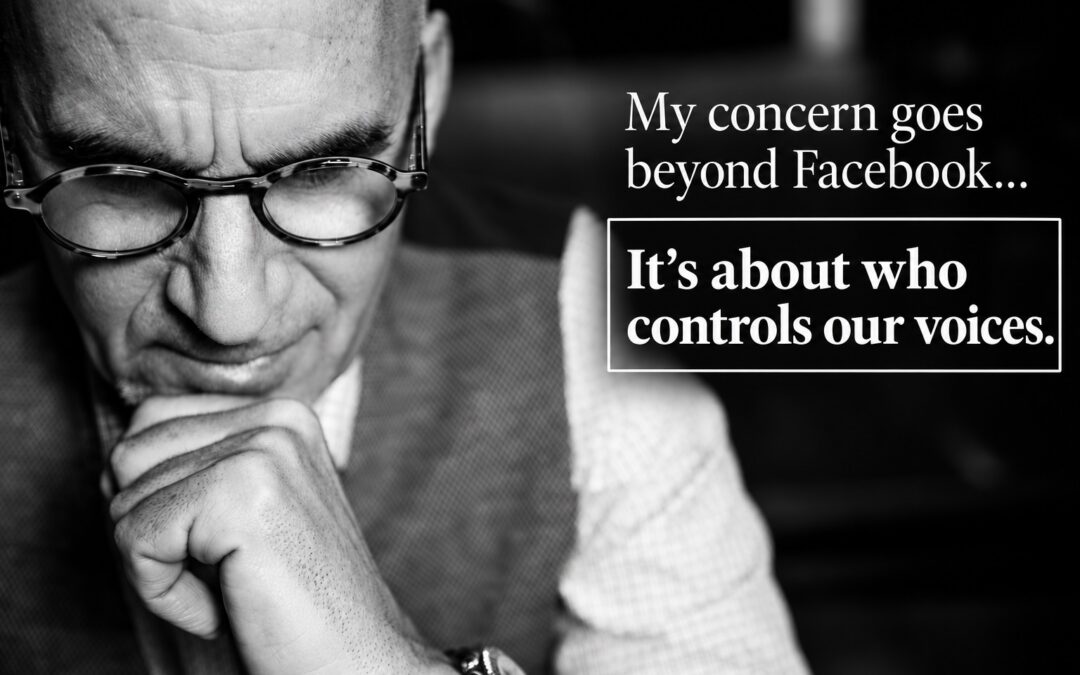
But my concern goes beyond a disappointing feed or declining engagement, and it goes well beyond Facebook.
I increasingly suspect that some of what is happening across social media is nefarious in nature. I don’t believe money alone explains it all. I worry about control, about whose voices get amplified, whose become harder to hear, and how those decisions may serve the political preferences, investments, and vision of society held by the people who own these platforms.
I can’t prove the intent behind every change, and I’m not suggesting that every post with little engagement has been deliberately suppressed. But I’m also unwilling to dismiss the concentration of that power as simply a business decision with no broader consequences.
Social media seemed to offer everyone a voice, a way to reach people without needing permission from a publisher, broadcaster, or other traditional gatekeeper. That possibility mattered. It opened doors for people, ideas, communities, and causes that might otherwise have struggled to be heard. Yet having the ability to post is different from having a meaningful opportunity to reach anyone. We can still speak, but the platform largely determines who gets to hear us. Even people who deliberately chose to connect with us may never see what we share.
Denise was told that paying to boost her posts was the answer. I can’t say why her engagement disappeared, but I understand the frustration of spending years building connections and then feeling as though access to those connections has become something you’re expected to purchase.
And I worry that even “pay to play” doesn’t fully describe the problem. What happens when the people controlling distribution also have strong interests in which political movements succeed, which investments gain attention, or which kinds of societal change take hold? We shouldn’t have to establish the motive behind every buried post before asking how much influence we’ve handed them.
We once celebrated social media for allowing us to bypass the gatekeepers. Now I wonder how much of that freedom we traded for convenience, and how dependent we’ve become on a different set of gatekeepers, the social media oligarchs whose platforms mediate so much of our public conversation.
The part that worries me most is what we’ve allowed to fall by the wayside in the process.
For too many of us, posting has become the default way to spread a message, support a cause, or express opposition. Other ways of reaching people, through direct conversations, independent blogs, email, community gatherings, organizing, and showing up in person, can receive less of our attention because posting is so easy. AND I say “us” deliberately, because I’m as guilty as the next person.
We share something, add our opinion, perhaps attach a hashtag, and feel that we’ve done our part. Then we move on. Meanwhile, that post may receive little distribution, perhaps never even reaching the friends who might have cared enough to respond or become involved. There’s something troubling about that combination… a platform that controls whether our message travels, and our own willingness to treat publishing the message as sufficient personal commitment.
Expressing support can matter. A post can inform someone, start a conversation, raise money, or help bring people together. I’ve seen it happen, and I wouldn’t dismiss that value. But I also have to ask myself what follows the expression. Did I reach out to anyone? Did I offer time, money, help, or sustained attention? Did I do anything that requires more of me than pressing “post”? If the platform barely distributes the message and I make no further effort, how much have I actually contributed?
That question concerns me far more than whether my latest post gets likes. I worry that we’ve become accustomed to feeling involved while becoming less personally engaged, and that the convenience of expressing ourselves has made it easier to overlook whether we’re reaching anyone or helping anything change.
So, at this moment, I’m adjusting both my expectations of Facebook and my expectations of myself.
I’m still here, still sharing, and still interested in what people have to say. I’m posting more because I want to express a thought, work through an idea, or leave something I can return to later. If it starts a conversation, wonderful. If someone finds value in it, even better. But I’m expecting much less from Facebook’s willingness or ability to bring us together.
I’m also making more of an effort to look for friends and family directly, and reminding myself that when a relationship or a cause matters, I need to carry that attention beyond the feed. There’s still a text, an email, a phone call, a visit, a meeting, or a commitment I can make and follow through on. RETURN ON RELATIONSHIP has always required attention, participation, and care. The platform can help facilitate those things, but it cannot do them for us, and I don’t want its decisions about distribution to determine how much effort I make.
My expectations of Facebook may be at zero… but my expectations of myself shouldn’t be. If I care enough to post about something, I need to consider whether I care enough to do something beyond posting. That’s the part I can control, and it’s the part I need to pay more attention to.