
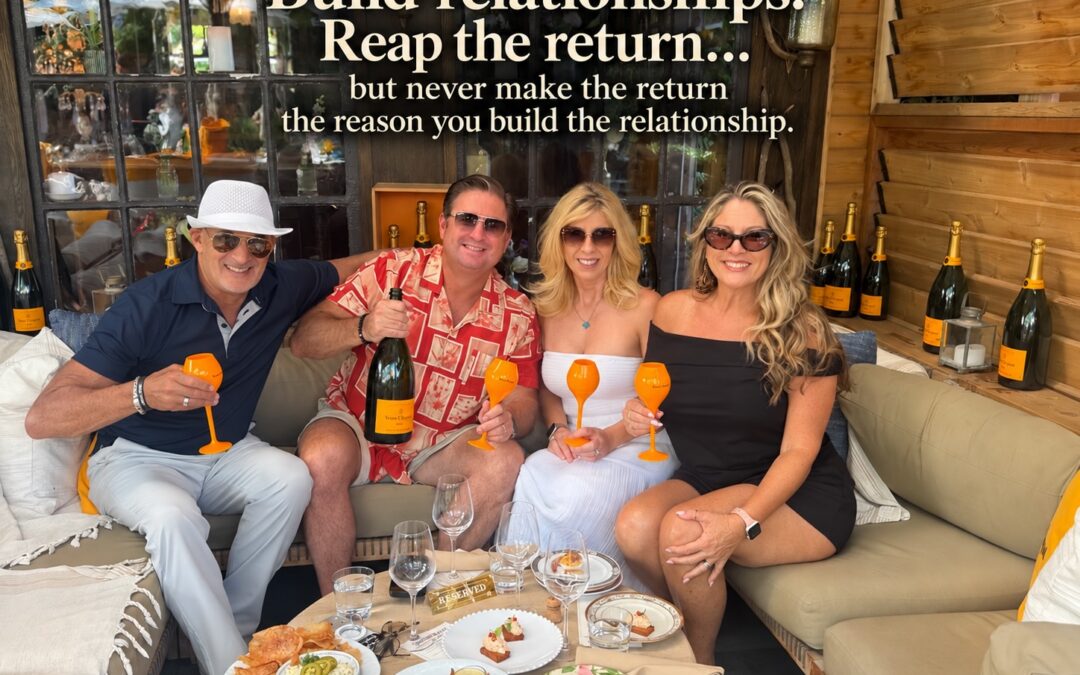
I’ve been talking about RETURN ON RELATIONSHIP, or RonR, for many years, and something I’ve come to realize is that the very phrase can sometimes lead people to misunderstand what I mean. When we hear the word “return,” especially in business, we’re conditioned to think about what we get back for what we put in. We think about investments, outcomes, and measurable results. It’s understandable, but when it comes to relationships, that interpretation couldn’t be further from what I’ve always believed.
RETURN ON RELATIONSHIP is not about what someone owes you because of what you’ve done for them. It’s about the value that comes from genuinely caring about people, building trust, showing up, and investing in relationships without keeping score.
Relationships are not quid pro quos, and the most meaningful ones rarely involve anything resembling an equal exchange. Whether we’re talking about friendships, family, colleagues, business associates, or even people we encounter briefly along the way, the return can take countless forms, many of which we may never recognize, much less measure.
Sometimes the return is an opportunity, a referral, an introduction, or someone stepping up when we need help. But just as often, it’s a conversation that changes our perspective, the comfort of knowing someone cares, the satisfaction of helping another person succeed, or simply the pleasure of spending time with someone whose company we enjoy. And sometimes the return is nothing more than knowing we did something good for someone else.
That last part matters more than many people realize.
I’ve always believed in doing for others without the expectation of anything directly in return. Not because I think generosity is some clever long-term strategy for eventually getting something back, but because being good to people is how I believe we should move through the world. It’s the foundation of my #BeGoodToPeople ethos, and it’s inseparable from everything I’ve said about RETURN ON RELATIONSHIP.
When we help someone, offer encouragement, share our knowledge, make an introduction, or simply take the time to listen, there shouldn’t be an invisible invoice attached. We shouldn’t be mentally recording what we’ve contributed so we can eventually collect on it. The moment we start approaching people that way, we’ve shifted from building relationships to managing transactions.
And this is where something else I’ve said for years comes into play… Relationships are like muscle tissue, the more you engage them, the stronger and more valuable they become.
Relationships don’t strengthen simply because we’ve made a connection, exchanged contact information, or known someone for a long time. They grow through engagement, attention, consistency, and the willingness to show up for one another. Just as muscles weaken when neglected, relationships can lose their strength when we stop making the effort. And importantly, that engagement doesn’t have to involve grand gestures or extraordinary sacrifices. Often it’s the little things, the calls, the conversations, the check-ins, the genuine interest in someone else’s life, that make the biggest difference over time.
There’s also another important distinction I’ve come to appreciate… Relationships don’t have to be equal to be meaningful, but they do need to be rooted in genuine care and respect.
In some relationships, we will give far more than we receive, at least in ways that are immediately visible. In others, someone may give us more than we could ever hope to repay. Circumstances change, people go through difficult periods, and what each of us has to offer changes along the way. A friend who needs our support today may be the one offering it years from now, or perhaps never in the same way… that doesn’t make the friendship any less valuable.
Of course, none of this means we should allow ourselves to be continually taken advantage of, or that mutual respect and consideration don’t matter. There’s a meaningful difference between giving without expectation and remaining in relationships where our kindness is consistently disregarded. We can be generous without keeping score while still recognizing when a relationship has become unhealthy or one-sided.
I think this distinction is especially important in business, where relationships are so often discussed in terms of networking, leverage, and what someone can do for us. I’ve never believed the best way to build a network is to collect contacts and calculate their potential usefulness. I’d much rather build relationships with people I respect, people I enjoy, and people whose success I genuinely want to support, whether or not there’s ever a direct business benefit.
That doesn’t mean business outcomes aren’t important. Of course they are. Trust, loyalty, advocacy, collaboration, and opportunity are all meaningful results of strong relationships, and some of those outcomes can absolutely be measured. But measuring the business impact of relationships is very different from treating the people in those relationships as investments that owe us a return. One is an effort to understand the value relationships create. The other risks reducing people to the value we think we can extract from them.
And that brings me to another belief I’ve expressed often, one that I think captures the heart of everything I’m talking about here… The most important RETURN ON RELATIONSHIP is FRIENDSHIP!
Not because every professional relationship needs to become a personal friendship, or because friendship should be viewed as something we acquire in exchange for our efforts. But because genuine friendship represents so much of what RETURN ON RELATIONSHIP is really about… trust, caring, shared experiences, mutual respect, and the simple pleasure of being there for someone, and knowing they care about being there for you.
Some of the most valuable relationships in my life are those where simply being together, regardless of what we’re doing, is what makes the time special… there’s no agenda, no expectation of a favor, no need to accomplish anything. The relationship itself is the value, and the friendship itself is the return. And that’s something no spreadsheet, marketing dashboard, or ROI calculation can ever adequately capture.
Sometimes the return shows up elsewhere in our lives, through people and circumstances we could never have anticipated. Sometimes it comes years later, and sometimes the only return is the satisfaction of having made a positive difference. The return is not necessarily what comes back to you… sometimes the return is what the relationship allows you to give, experience, and become.
I don’t want anyone to interpret RETURN ON RELATIONSHIP as a formula for getting more out of people. I’ve always intended it as a reminder that the relationships we build, nurture, and respect are among the most valuable parts of our personal and professional lives, even when that value can’t be quantified.
Be Good To People because it’s the right thing to do. Help when you can, show up when it matters, celebrate other people’s successes, and recognize that what you give to a relationship doesn’t have to come back in equal measure, or even come back at all, to have been worthwhile. That’s the RETURN ON RELATIONSHIP I believe in, the one I’ve sometimes struggled to embrace, but the one I’ve always come back to… and the one I hope people understand.
Build relationships. Reap the return… but never make the return the reason you build the relationship.