
I came across a post from Vanessa Sain-Dieguez that immediately brought me back to a moment when social media actually worked the way many of us had hoped it would. Her post is worth the read. When she helped scale social at Hilton, the shift wasn’t about content, it was about mindset. Social wasn’t just about brand and performance marketing… it had became about service. BECAUSE CONSUMERS, at that time, HAD A VOICE. So brands responded with a REAL HUMAN VOICE, clear escalation paths, and issues handled quickly. If a customer, or guest, had a problem, it wasn’t left sitting in a report; it was addressed in real time, human to human. That’s when social became powerful, about RETURN ON RELATIONSHIP, and customer advocacy, because brand was no longer built in what you said, but in how you showed up when it mattered.
Somewhere along the way, that changed. Most brands have quietly drifted back to broadcasting, not because they don’t understand the value of engagement, but because the system no longer rewards it. And I don’t believe that’s accidental. So many brands have actually DISMANTLED their consumer engagment teams. Platforms have evolved to prioritize what drives revenue… paid amplification, scalable content, and controlled visibility. Customer complaints, one-to-one outreach, and real-time service don’t fit neatly into that model. They don’t scale the same way, they don’t monetize the same way, they are not as easily measurable, and they don’t benefit from being widely distributed.
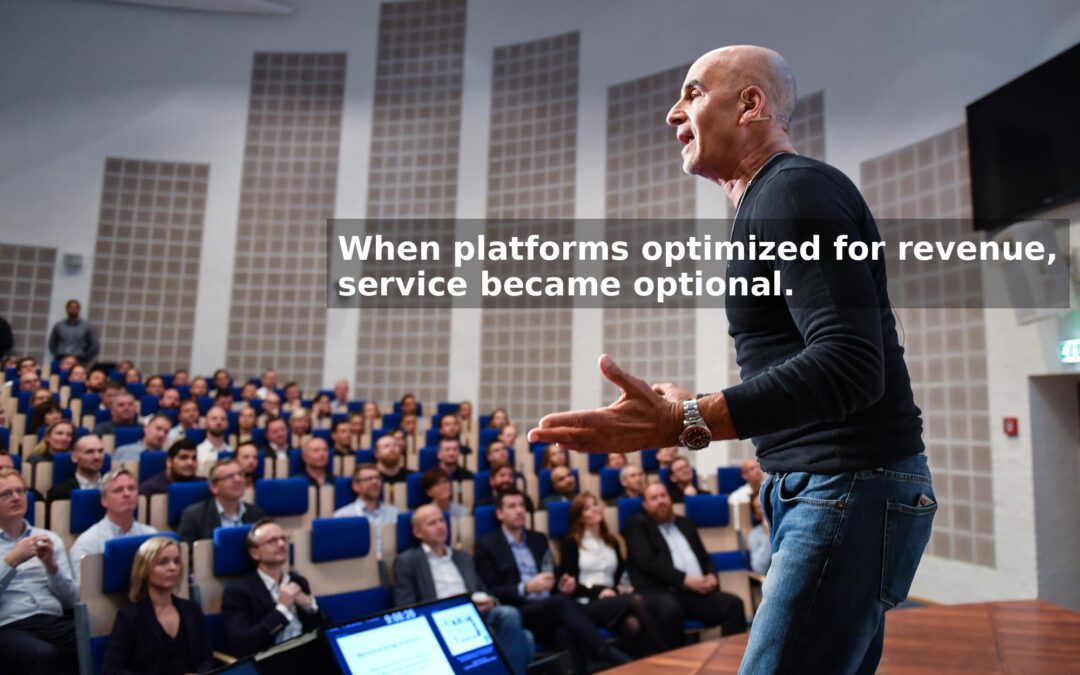
As a result, they receive less visibility, and when something gets less visibility, it begins to feel less important…. and in the marketing world it likely becomes… UNIMPORTANT. Over time, brands internalize that lesson. Not because anyone explicitly told them to ignore customers, but because the outcomes speak for themselves. If complaints don’t spread, they don’t require the same level of response. If outreach isn’t widely seen, it doesn’t feel as urgent. If engagement doesn’t drive reach, it becomes harder to justify dedicating resources to it. And just like that, service becomes optional.
There doesn’t need to be a formal agreement between platforms and brands for this to happen (it feels more like a wink and a nod than anything explicitly stated). The alignment of incentives takes care of it. When platforms profit most from advertising and brands benefit from more controlled narratives, both sides naturally move in the same direction… not necessarily through explicit coordination, but through shared economic interest. And in that shift, the consumer is often left believing they are being heard, when in reality they are simply not being seen…. and truth be told anyone who is paying attention can see that any posts with negative brand commentary do not get not likes, comments or shares… when in the past some were the most active.
I’ve written before about this broader shift in how platforms shape what we see and what gets engagement. In Social Media Isn’t Broken… It’s Controlled, I explored how visibility itself has become curated in ways that serve platform and advertiser priorities. This is a continuation of that same pattern… just playing out in customer service and experience instead of content distribution.
That’s the part that should concern all of us, because the real value of social was never in the broadcast, it was in giving each individual a voice, and in the the response and engagement. It was in the moment a brand chose to acknowledge, engage, and resolve something in real time. That’s where trust was built, and that’s where RETURN ON RELATIONSHIP was earned. That hasn’t changed. What has changed is how easy it has become for brands to ignore it… and convince themselves that it either doesn’t matter, or that they can earn that same RETURN ON RELATIONSHIP by telling people what to think and controlling the narrative.
Ignoring it doesn’t eliminate the need… it simply delays the consequences. Relationships don’t disappear when neglected, they weaken, and when something eventually goes wrong, when an issue does break through the noise, there is no foundation to support the brand… no SOCIAL INSURANCE.
There is no trust, no benefit of the doubt, and no pause before judgment. That pause matters more than ever, because in a world where narratives form quickly, it can be the difference between a moment and a meltdown.
The platforms may continue to optimize for attention, but brands still have a choice. They can follow the incentives, or they can invest in the relationships that actually sustain them over time. In the end, the brands that win will not be the ones that were seen the most, but the ones that showed up when it mattered. Relationships are the true currency, and that hasn’t changed.