
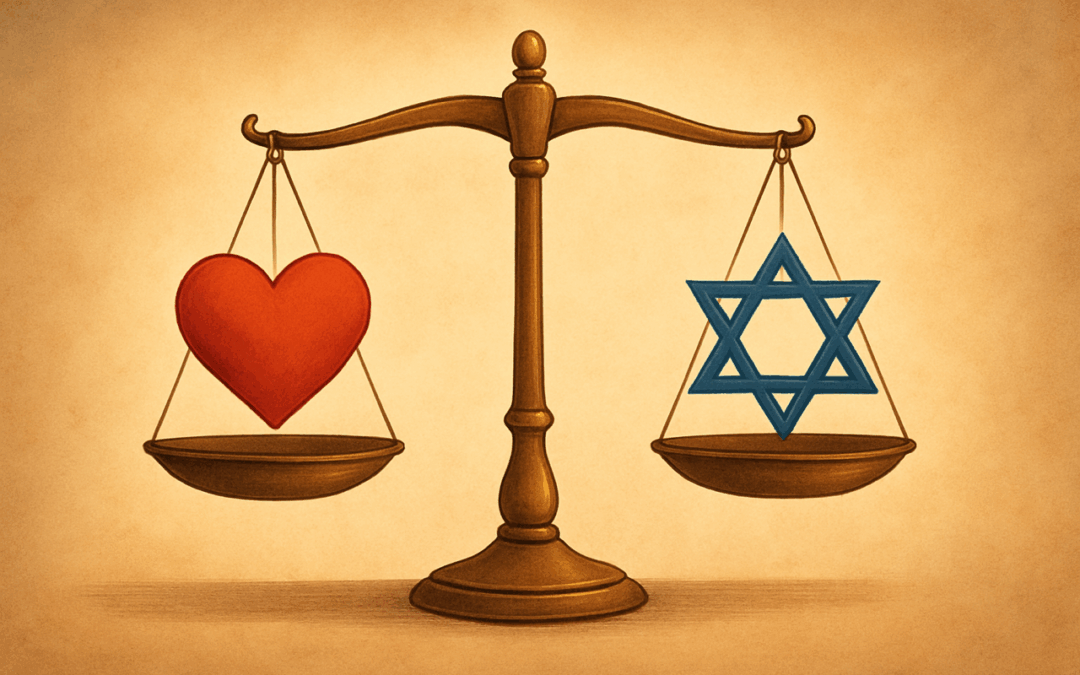
There’s a label, used more often lately in debates about Israel and Jewish identity, for when a Jewish person questions power, challenges injustice, or calls out actions done in the name of Judaism that betray its deepest ethical values… THAT LABEL IS “SELF-HATING JEW.”
It’s not a critique, it’s a weapon… meant to discredit rather than engage, to shut down dialogue rather than face uncomfortable truths. Too often, it’s used not to defend Judaism, but to defend nationalism.
Jewish history is rich with dissent… vibrant, necessary, and long seen as a source of strength. Progressive, secular, and diasporic Jews have always argued, debated, and wrestled with our collective conscience. Sadly, that tradition is rarely embraced when it’s directed at the intentions and actions of the Israeli government.
When “Zionism” is equated with Jewish identity itself, we erase the vast spectrum of Jewish thought… religious, secular, cultural, and political. Worse, we also allow identity to be weaponized, policing dissent, and punishing those who speak from a place of deep loyalty to our values.
Call me what you will, “self-hating Jew,” “kapo” (I hear these daily from those who choose name-calling instead of dialogue)… I stand by my morals. Israel has, in my view and that of many others, taken the path of an oppressor state. It needs a profound change of direction if it is to truly represent Jews worldwide.
Zionism was once a vital mission for the Jewish people… that mission succeeded. Israel exists. It thrives. It is no longer a dream or a fragile hope… it is a fully established country with highways, hospitals, Nobel Prize winners, bureaucracy, a booming tech sector, and a formidable military.
So when someone in 2025 calls themselves a Zionist, I don’t see a freedom fighter… I see someone waving a historical banner for a revolution that ended decades ago. Yes, there are groups and countries that call for Israel’s destruction, but that’s no longer a realistic threat. Only Israel itself can now turn it into a pariah state. Calling yourself a Zionist today is, as my friend Saul Colt put it, like calling yourself a Minuteman in modern America… nostalgic, maybe even noble in intention, but the fight you reference has already been won. *See Saul’s post here, he recently (9/4/25) told me that I misinterpreted his meaning, perhaps I did (?)… but I believe in using it, my point stands clear.
Many Jews were aligned with what Zionism was, not with what it has become. We abhor the 30+ years of oppression leading to this moment. Zionism was the movement for Jewish self-determination and statehood in our ancestral homeland… 🇳🇮 MISSION ACCOMPLISHED 🇳🇮. It should never be about supporting an oppressive, ultra-right-wing apartheid state bent on erasing another people simply because it is Israel and loyalty must trump all.
I know most who use these labels mean well. They value loyalty and believe they’re defending our people. But we’ve been led to believe the old mission still serves us, and that their actions today advance it. They don’t. It’s time for a new mission, one rooted in justice, compassion, equality, and respect for all people. It won’t be easy, but lasting change never comes without struggle.
We are not safer when we silence dissent.
We are not stronger when we destroy indiscriminately.
And we are certainly not righteous when we become the oppressor.
ADDING TO THE POST… I now understand that Israel has sadly, even in the original vision, always had the intention of removing others to make room for the Jewish people and create a state, regardless of the cost to those already living on the land, denying their rights and humanity, and building a national project rooted as much in displacement as in aspiration, with little space left for true coexistence in its founding framework.
This is not simply hindsight… Theodor Herzl wrote in his diary in 1895 about the need to ‘spirit the penniless population across the border’ to make way for Jewish settlement; Chaim Weizmann, later Israel’s first president, described the Arab population as a ‘problem’ to be solved; and Yosef Weitz, a senior figure in the Jewish National Fund, bluntly declared in the 1940s that ‘there is no room for both peoples in this country.’
Beyond words, the killing started early and often, from clashes between early Zionist settlers and Palestinians in the late Ottoman period, to the Nabi Musa riots of 1920 (dozens killed), the Jaffa riots of 1921 (nearly 100 killed), the Hebron massacre of 1929 (scores of Jews murdered, followed by brutal reprisals against Arabs), and the Arab Revolt of 1936–39, which saw thousands killed on both sides as Britain and the Yishuv crushed Palestinian resistance. By 1947–48, as the state of Israel was being established, violence escalated into organized campaigns of expulsion, with atrocities like Deir Yassin and the destruction of more than 400 Palestinian villages underscoring that the vision of statehood was pursued not only through settlement and diplomacy, but also systematically through force. These voices and events reveal that transfer, removal, and violence were embedded early in the Zionist project, even as it also carried ideals of refuge and renewal.