
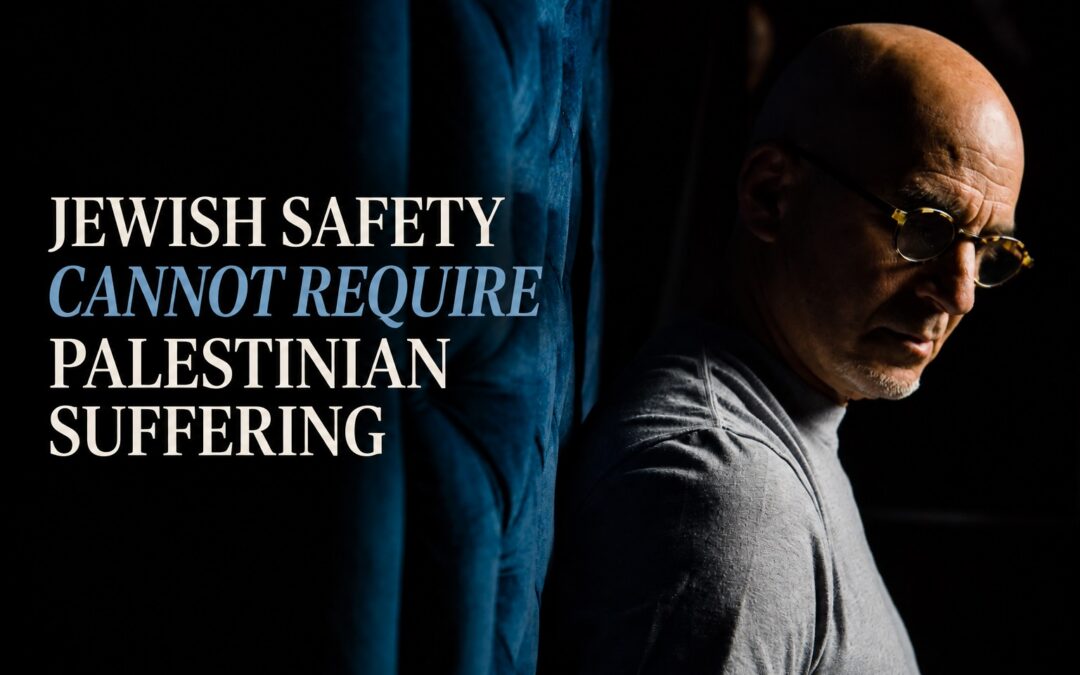
I recently came across these words from Robert Rosenthal, and they stopped me because, whether someone agrees with every word or not, they capture much of where my thinking has arrived after years of questioning what I was taught, listening to others, reading, writing, and trying to separate my Jewish identity from the political narratives that have been wrapped around it.
“Israel isn’t a global pariah because of antisemitism; it’s a global pariah because of 78 years of Israeli oppression… ethnic cleansing, ghettoization, erasure, occupation, apartheid, and genocide.
Why is the world finally outraged? Because Palestinians live-streamed Israel’s genocide. Zionists told anyone who didn’t share their anti-Palestinian bias not to believe their lying eyes, and claimed the victims deserved their plight. As a result, that movement is being viewed more negatively than ever.
The way forward is for Israeli oppression to end, with equal rights for every human being from the river to the sea, regardless of religion, ethnicity, or race.”
~Robert Rosenthal
I originally shared his words via Facebook with a simple comment of my own… #SadButTrue, the righteous in the Jewish Community need to stand tall and speak up. 🙏🏻✡️🙏🏻
But the more I sat with it, the more I realized there was much more I wanted to say, because this connects directly to a progression in my own thinking that I have been sharing for quite some time.
I have written about Jewish survival and Jewish conscience, the very real and disturbing growth of antisemitism, why fighting antisemitism cannot require blind loyalty to Israel, the conflict between my heart and my heritage, tribalism and what happens when we lose our curiosity, and more recently the danger of calling virtually every criticism of Israel antisemitism. Through all of it my thinking has continued to evolve, but one thing has remained constant… Jewish life is sacred, and nothing I believe about Israel or Palestinians changes that.
What has become much clearer to me is that acknowledging the sacredness of Jewish life can never come at the expense of denying the sacredness of Palestinian life. Both are true, both have to matter, and when we elevate one while minimizing the other, we don’t just lose moral clarity… we lose credibility, humanity, and ultimately the foundation of what we claim to stand for.
Antisemitism is real. I have experienced it, written about it, pushed back against it, and I will continue to do so whenever I see it. But Palestinian suffering, anti-Palestinian racism, and dehumanization are real too, and outrage over what Israel has done to Palestinians cannot simply be dismissed as hatred of Jews. When we label virtually every criticism of Israel antisemitism, we don’t strengthen the fight against antisemitism… I believe we weaken it, because we make it increasingly difficult to distinguish genuine hatred of Jews from outrage over the actions of a government and a country.
Increasingly I believe separating Judaism and Jewish identity from the actions of the Israeli government is essential to protecting both. Israel cannot continually claim to speak and act for Jews everywhere, while much of the Jewish community reinforces that connection, and then expect the rest of the world to completely separate one from the other when it witnesses actions it considers morally indefensible.
That connection goes much deeper than simple solidarity. For generations, the Israeli narrative has deliberately reinforced the idea that Jewish safety everywhere is inseparable from the existence, strength, and security of Israel, that when Israel is threatened Jews everywhere are threatened, and when Jews anywhere are threatened Israel is their ultimate refuge and protector. In my view, that narrative has helped solidify the very linkage between Israel, Zionism, and Jewish identity that puts the global Jewish community at risk because of the actions of Israel.
And there is another uncomfortable part of this that I believe needs to be said. I am not suggesting Israel intentionally creates antisemitism, nor that Israeli leaders want Jews anywhere to be attacked, but I do believe the Israeli political narrative embraces and makes use of the existence of antisemitism because it reinforces one of its foundational messages… the world remains dangerous for Jews, Israel is the one place that ultimately guarantees our safety, therefore Israel must remain militarily powerful and Jews everywhere must stand behind it.
The perception of an enemy perpetually at the gates serves that narrative extraordinarily well. Fear can be legitimate and still be politically useful, antisemitism can be real and still be exploited, and genuine threats to Israel can exist while political leaders use those threats to advance agendas that go well beyond protecting Israeli lives. For hardliners committed to continued settlement and territorial expansion, a constant sense of existential threat can make policies that might otherwise be much harder to justify appear necessary for survival.
October 7 has made these questions even harder for me to ignore. I have profound unanswered questions about what happened before that horrific day, particularly as more information has emerged about warnings and intelligence failures leading up to the attack. I believe Netanyahu knew far more about the possibility of a major attack than we were originally led to believe, and I am deeply suspicious about why so many warnings failed to produce the response they should have. But I recognize the difference between what I believe and what has been proven, and there is no evidence establishing that Netanyahu knowingly allowed October 7 to happen. I will not turn my suspicion into fact simply because it fits my view of him, but neither am I willing to stop asking the question.
October 7 opened the door to an extraordinary expansion of Israeli military action and fundamentally altered Netanyahu’s political circumstances. The war that began in Gaza expanded into a much broader regional conflict, Israel established or expanded military buffer zones and operations beyond its borders, and Netanyahu remained in office while continuing to face his long-running corruption trial. None of that proves he allowed October 7 to happen, but it makes knowing exactly what he knew, when he knew it, what warnings reached him, and why they were not acted upon absolutely essential. The victims of October 7 deserve those answers, Palestinians who have suffered everything that followed deserve them, and Israelis and Jews around the world deserve them as well. Curiosity cannot end precisely where the answers might make us uncomfortable.
That brings me back to a contradiction I believe we in the Jewish community need to confront. If we accept the premise that Israel represents Jews everywhere, that Israel’s security is Jewish security, and that threats to Israel are threats to Jews everywhere, can we really be surprised when people outside our community begin making that same connection in the opposite direction? We cannot insist upon the linkage when it strengthens support for Israel, then demand complete separation when Israel’s actions generate outrage around the world.
None of this makes Jews responsible for the actions of Israel, and absolutely nothing Israel does excuses anyone who directs hatred, harassment, or violence toward Jewish people… antisemitism belongs to the antisemite. But if we genuinely want Jewish people to be understood as separate from the actions of an Israeli government, those of us in the Jewish community have an even greater responsibility to challenge that conflation ourselves, especially when Israeli political leaders and Jewish political organizations in the U.S. encourage it.
This is part of why Rosenthal’s words hit me as hard as they did. People can, and certainly will, argue about his terminology. Words such as apartheid, ethnic cleansing, and genocide carry legal, historical, and emotional weight, and there are fierce disagreements over their application to Israel, Gaza, and the Palestinian territories. But I worry that the battle over terminology has too often become a way to avoid looking at the human beings underneath it.
Something has fundamentally changed in this conflict… Palestinians can show the world what is happening to them in real time. Their lives, destroyed homes, dead and injured children, grieving families, fear, anger, and desperation arrive directly on screens around the world, without first having to pass through governments, political organizations, traditional media, or advocates explaining to the rest of us what we should believe.
That doesn’t mean every image tells the entire story, every social media post is accurate, or context no longer matters. Of course it does. But simply telling people that what they are seeing is propaganda, that criticism is antisemitism, or that Palestinian suffering is somehow an unfortunate but necessary consequence of Jewish security is not an answer I can accept.
This is where something else I have written about recently becomes especially important to me… curiosity. Tribalism makes curiosity extraordinarily difficult because once we are certain our side possesses the truth, asking questions can begin to feel like betrayal. But curiosity keeps conviction from becoming a cage, and understanding Palestinian history, pain, anger, and aspirations does not require abandoning Jewish history, pain, fear, or aspirations, any more than recognizing genuine antisemitism requires defending everything Israel does. We should be capable of holding more than one truth at a time.
That is also why I continue to believe Jewish and Muslim communities should be natural allies against hate rather than adversaries. Both know what it means to be stereotyped, feared, dehumanized, and attacked simply because of who they are, yet instead of allowing that shared experience to bring us closer, political and religious tribalism too often turns our respective histories of suffering into competing claims for sympathy, legitimacy, and righteousness. I don’t want to participate in that competition.
I grew up being taught not to be afraid as a Jew, to stand tall, be proud of who I am, embrace the world around me, and speak up when something is wrong. I don’t believe honoring that heritage requires me to defend the actions of a government simply because it calls itself the Jewish state, and I certainly don’t believe Jewish survival requires Palestinians to live without the same dignity, freedom, safety, and rights I demand for Jews. The older I get and the more I examine all of this, the more I believe the moral lessons I take from Jewish history compel me to oppose dehumanization, oppression, collective punishment, and the misuse of fear wherever I believe I see them. That isn’t a rejection of my Jewish identity… it is an expression of it.
And perhaps that is ultimately why Rosenthal’s final sentence resonates with me most. Whatever political structure eventually emerges, whatever name is placed on it, and however difficult the road to get there, I cannot see a morally sustainable future that does not begin with a very simple principle… every human being living between the river and the sea deserves equal human dignity and rights, regardless of religion, ethnicity, or race. That means Jews, Palestinians, Muslims, Christians, Israelis, Arabs, and everyone else who calls that land home.
My concern for Jewish safety doesn’t diminish when I say that, nor does my willingness to confront antisemitism weaken. If anything, I believe both become more credible when I refuse to demand rights and humanity for my own people that I am unwilling to demand for someone else’s.
So I come back to what I wrote when I first shared Robert Rosenthal’s words…
#SadButTrue… the righteous in the Jewish Community need to stand tall and speak up. 🙏🏻✡️🙏🏻
Not because we should be ashamed of being Jewish, but because we should be confident enough in who we are to question what is done in our name, not because Jewish lives matter less, but because Palestinian lives cannot matter less, and not because every criticism of Israel is justified or every critic is free of antisemitism, but because our history, our values, and our humanity demand that we know the difference.
Jewish life is sacred, Palestinian life is sacred… neither truth diminishes the other, and neither should ever require us to deny the humanity of anyone.