
After publishing “Jewish Safety Cannot Require Palestinian Suffering,” I shared the full article directly on Facebook because, in my experience, links rarely get much distribution there. The response was striking… so far, more than 1,500 likes, 291 shares, and over 950 comments. Perhaps those numbers aren’t unusual for some people, but they are quite a lot for me. Beyond the numbers, what stayed with me was the conversation the post generated, including the support, the disagreement, and the exchanges that challenged me to explain more clearly what I believe and why.
Those conversations brought me back to a question… when we defend Israel, what exactly are we defending? The safety of its people, the decisions of its government, our connection to our heritage, or a story we have come to believe we cannot question without putting ourselves at risk?
Those are different things, yet in these conversations they often become inseparable. A criticism of government policy is heard as an attack on Jewish existence, acknowledgment of Palestinian suffering becomes a denial of Jewish suffering, and asking whether Israel’s actions actually make Jews safer is treated as evidence that we do not understand the danger Jews face. I understand that fear. I am Jewish, and Jewish history is part of my history. But understanding where fear comes from does not mean accepting every conclusion drawn from it, especially when those conclusions require us to minimize another people’s humanity.
Several recurring arguments in the comments deserve more than another reply buried in a thread, because they reveal how we keep arriving at the same conclusions without examining the assumptions beneath them.
One was that removing or disarming Hamas is the only solution, as though that answered the concern I raised. Hamas’s atrocities, its weapons, and the question of who governs Gaza are serious issues. Nothing in my post excused the murder or kidnapping of civilians, and nothing about Palestinian rights requires defending Hamas. But Palestinian humanity cannot remain on hold until those issues are resolved. Civilians still need protection, food, shelter, and a future, regardless of who claims to represent them.
Some responses treated my argument as though I were blaming Jews for Hamas. That reverses what I was saying. Jewish people, the Israeli government, Palestinian civilians, and Hamas must not be collapsed into collective identities that make everyone responsible for everything done in their name. If we reject collective blame when it is directed at Jews, we should recognize why it is wrong when directed at Palestinians.
Another argument described Israel as having tried to live peacefully alongside Gaza, allowing Hamas to govern despite the occasional projectile attack. Rocket attacks on civilians were real and unacceptable, and calling them “occasional” does not capture the fear they created. But neither does describing Gaza as a neighbor simply left to govern itself capture the conditions Palestinians experienced.
The documented history of restrictions and blockade includes severe limits on movement, trade, access to fishing waters, and materials needed for civilian infrastructure. Restrictions intensified after Hamas’s takeover in 2007, with Israel citing security concerns; Egypt also restricted access through its border. Those conditions, alongside recurrent hostilities and failures of Palestinian governance, shaped everyday life well before October 7.
Acknowledging that history does not justify October 7. It challenges the idea that we must either excuse Hamas or accept a picture of Gaza that leaves out the restrictions imposed on its population. We should be able to condemn attacks on Israelis while examining what Palestinians were living through. The repeated claim that Palestinians have been offered a state and simply rejected it also deserves closer examination. There have been negotiations and proposals, and Palestinian leadership has decisions and failures to answer for. But “they were offered a state” is the beginning of a discussion, not its conclusion. What territory was proposed, how connected would it have been, what authority would Palestinians have exercised, and what continuing powers would Israel have retained?
The Clinton parameters, for example, envisioned a sovereign Palestinian state while also accommodating Israeli security requirements. The substance of those arrangements matters, as do the reasons negotiations failed. We cannot reduce that history to a slogan and then use the slogan to make generations of Palestinians responsible for living without a state. My concern is whether the sovereignty being discussed would allow Palestinians to meaningfully govern their own lives, rather than remain subject to another government’s overriding authority. Israeli security deserves serious consideration, but Palestinian freedom cannot be treated as whatever remains after every Israeli demand has been satisfied.
That connects to another response… that ending Palestinian suffering is up to Palestinians themselves, and that arguments like mine deny their agency.
Palestinian leaders and armed groups must answer for their choices. But agency and control are different things. People can make consequential decisions while still living under constraints they did not choose and cannot remove themselves. Recognizing their responsibility does not erase the responsibility of a government exercising power over their lives. The reverse matters too. Israel’s government makes choices; its policies are not inevitable responses beyond examination. Accountability cannot be assigned to Palestinians while Israeli decisions are presented as though there were never any alternatives.
As I wrote recently in “Changing the Leadership Is Not Changing the Policy,” we also need to examine what we expect a change in leadership to accomplish. Opposing Netanyahu does not automatically mean opposing the policies that deny Palestinians meaningful freedom and sovereignty. Differences among leaders matter, but if we criticize the person while continuing to defend the underlying policies, we have only taken the conversation so far.
Other exchanges turned on whether Palestine had existed as a sovereign state, whether Palestinians left their homes voluntarily, or what neighboring Arab countries should have done. Those questions deserve historically accurate answers, but they cannot determine whether Palestinians have rights today.
A person does not need a previously recognized nation-state to have a home, a family, or a community. Palestinians did not cease to exist in 1948, and claims that they simply left voluntarily flatten a history that included flight from war and fear as well as direct expulsions. The history of that displacement deserves to be confronted, not explained away as a population casually choosing to abandon its homes. Nor does acknowledging it erase Jewish displacement, persecution, or the need for refuge. The suffering of Jews forced from their homes does not cancel the suffering of Palestinians forced from theirs. Whatever failures neighboring governments need to answer for, those failures do not erase what displaced people lost.
Even if we accepted someone’s account of every failed negotiation, every rejected opportunity, and every hostile act, we would still have to ask what treatment of civilians is acceptable. An explanation of how a conflict developed cannot serve as unlimited permission for what happens next.
The “barbarians at the gates” framing raised another concern for me. I understand the fear behind it, particularly after atrocities that made people feel profoundly vulnerable. But when that language expands from those responsible for violence to a whole population, it makes it easier to stop seeing individual human beings. Families become a threatening mass, children become future enemies, and almost any action can begin to sound necessary.
Fear can be legitimate and still be politically useful, just as antisemitism can be real and still be exploited. I believe hardline leaders benefit from a public that experiences the enemy as perpetually at the gates, because that outlook makes questioning their policies feel like abandoning our own protection. We should ask who benefits when military dominance and territorial expansion are presented as permanent necessities, while a political future grounded in Palestinian freedom is dismissed as naïve.
Here in the United States, that framing can also distort where we direct our attention. I am deeply concerned about the threat to Jews from far-right extremists, white supremacists, white nationalists, and neo-Nazis in our own country. Their hatred of Jews cannot be resolved by an Israeli military operation or explained away as a response to Palestinian suffering.
We have already seen the consequences. The gunman who murdered eleven worshippers at Pittsburgh’s Tree of Life synagogue acted on white-supremacist and antisemitic beliefs. In California, the man who attacked the Poway synagogue also admitted setting fire to a mosque because he wanted to kill Muslims and Jews. These attacks expose both the danger facing us and the common ground we should recognize with other targeted communities.
That is why I resist treating Islam or Palestinians as our defining enemy. Neither a religion nor a people can be reduced to the extremists who claim to act for them. Antisemitism must be confronted wherever it appears, including in Islamist extremism and movements claiming to support Palestinian rights. But we cannot allow our focus on Israel to obscure the antisemites organizing here at home, including those whose political allies may profess support for Israel. Support for a state does not, by itself, establish concern for Jewish people.
If we are going to speak about danger at our gates, we need to look honestly at our own doorstep. I believe we devote far too much attention to defending Israel as the answer to Jewish insecurity, and far too little to confronting the domestic movements that threaten us alongside Muslims, immigrants, and other minorities. Building relationships with those communities should be part of how we protect one another.
Recognizing those threats does not diminish the need for Israeli safety. It does challenge the assumption that Jewish security everywhere can be secured through Israeli power. I want Israel to continue to exist as a country, but I do not believe preserving its identity as a Jewish state can justify denying Palestinians equal rights. My own preference is one democratic state in which Israelis and Palestinians have equal citizenship, equal political rights, and meaningful representation, with neither people’s safety or belonging dependent on the other’s subordination.
I recognize how unlikely that outcome appears, and how much fear, mistrust, and opposition would have to be overcome. It would require enforceable protections for both peoples, accountability for violence, and a serious commitment to repairing the harm Palestinians have suffered. Palestinian leaders and armed groups would have responsibilities in that process as well. But acknowledging the difficulty cannot mean accepting permanent inequality as the only realistic future. Military power can respond to an immediate threat; it cannot, by itself, create the trust and political conditions that allow people to live together safely.
For Jews outside Israel, there is another consequence to consider. I believe Israel’s actions can make Jews less safe globally when anger at its government becomes a pretext for people to target Jews elsewhere. Holding a Jewish person responsible for an Israeli government decision is antisemitic, and responsibility for that hatred belongs to those who choose it. We can condemn that hatred while questioning the insistence that Israel speaks for all Jews. When a government’s actions are presented as an expression of Jewish identity, the distinction between a state and a people becomes harder to maintain. I want that distinction defended consistently, including by those who claim to speak in our name. I believe blurring those identities is politically useful to leaders who want support for their government treated as an obligation of Jewish belonging. If criticism can be recast as disloyalty to our people, they gain protection from accountability while Jews everywhere are pushed into an association with decisions we did not make.
Dismissing an argument as “goysplaining,” or suggesting that a Jew who disagrees somehow fails to understand Jewish vulnerability, also avoids engaging with what has actually been said. My Jewish identity does not make every conclusion I reach correct, but neither does someone else’s identity settle the disagreement. We still have to examine the facts, the reasoning, and the consequences.
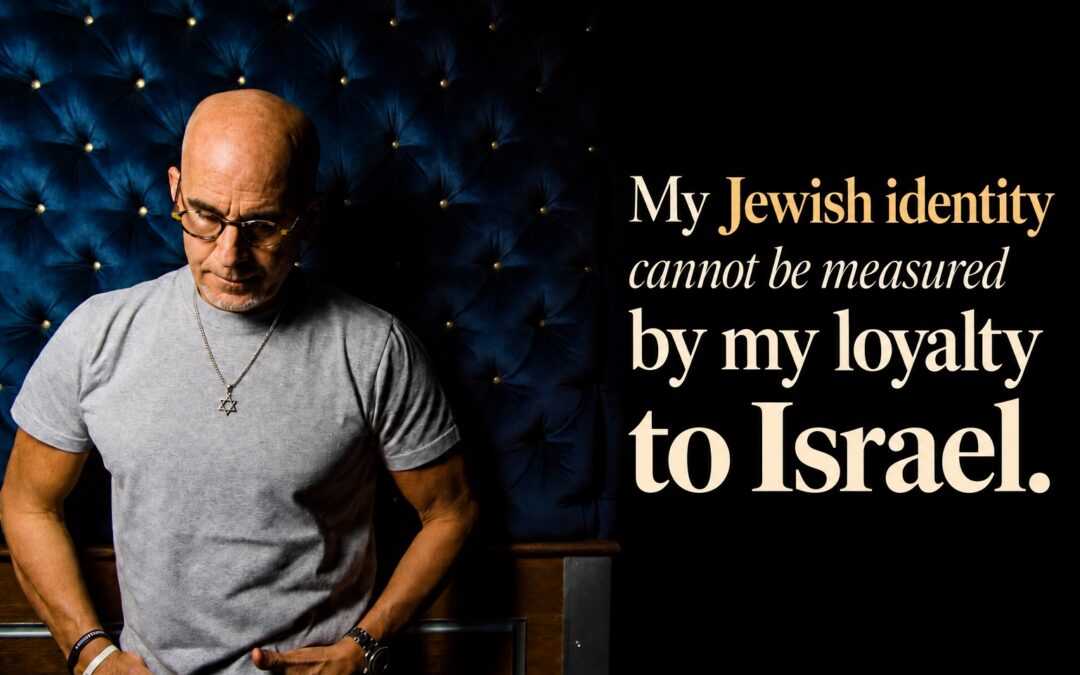
In the conversations I have with other Jews, I increasingly see attachment to Israel becoming central to Jewish identity, sometimes even more central than their connection to a synagogue, a local community, or religious practice. I am concerned about what happens when that attachment becomes a measure of someone else’s Jewish belonging, making disagreement feel like betrayal rather than an expression of conscience. My Jewish identity cannot be measured by my loyalty to Israel. It lives in my history, my relationships, my values, and the responsibility I feel toward other human beings, including those whose suffering challenges the narrative I grew up with.
I do not assume that everyone defending Israel lacks compassion. Many are speaking from fear, grief, family ties, or a sincere conviction that they are protecting people they love. Those connections deserve understanding… but understanding someone’s attachment does not require accepting their argument, especially when it leaves little room for the lives of others.
Relationships matter to me, and so does the willingness to have difficult conversations within them. Those conversations give us an opportunity to understand each other’s fears while questioning what those fears are being used to justify.
“Jewish Safety Cannot Require Palestinian Suffering” began this discussion with a moral conviction. The exchanges that followed brought the question of belonging into sharper focus… what happens when defending a state becomes a condition of belonging to a people?
I want a future in which Jewish families can live without fear and Palestinian families can live without having to plead for recognition of their humanity. I do not have a simple blueprint for getting there, but I know that we move further from it whenever either people’s suffering becomes an acceptable price for the other’s security.
As a Jew, I want us to be safe. I also want us to remain capable of asking whether what we are defending is helping make that possible, whether the religious or political beliefs we are defending deserve our support, and whom that support asks us to disregard along the way. The right of people to live in safety and dignity should never be in question, but the beliefs and policies advanced in their name must remain open to scrutiny.